

Hybridan Monthly, 3 November 2026
Market Comment: View from the Broker's Desk:
Small Caps, Big Themes: Jackdaw Is Just the Start: Powering Britain's AI Future
The approval of the Jackdaw gas field is good news for UK energy security. However, its significance should extend well beyond a single North Sea development. We hope it triggers a domino effect of common sense across UK energy and infrastructure policy. This debate is no longer confined to the merits of oil and gas; it is increasingly about whether Britain has the infrastructure to support the industries that will define its economic future.
AI is a prime example, vast amounts of capital is being invested in AI companies, semiconductor chips and computing infrastructure. Yet behind all of it sits a fundamental requirement: electricity. Without reliable, affordable power, even the most sophisticated AI model is little more than expensive software waiting for a plug socket. The UK wants to develop world-leading technology businesses, attract international investment and retain the next generation of AI companies, but these ambitions count for little if the infrastructure required to support them is unavailable. The Jackdaw decision should be part of a much bigger conversation about energy security, economic competitiveness and Britain's ability to build.
The International Energy Agency expects global data-centre electricity consumption to more than double to around 945 TWh by 2030, with AI a key driver of growth. This creates an investment opportunity extending well beyond companies developing AI models. It encompasses data centres, electricity generation, cooling systems, connectivity and the energy infrastructure required to run them. There is a catch: the infrastructure must exist before the opportunity can be realised. Grid connections and planning are already constraints on UK data-centre development, just as demand for AI infrastructure accelerates. If power cannot be delivered where it is needed, projects are delayed, investment becomes less attractive and businesses have an incentive to locate elsewhere.
The proposed AI supercomputer development in Loughton, Essex, illustrates the challenge. Intended to become the UK's largest AI supercomputer, the project requires up to 90MW of power. Yet UK Power Networks has indicated that sufficient grid capacity may not be available until the early-to-mid 2030s, potentially pushing the connection well beyond its planned 2027 launch. Nscale has been exploring onsite power generation and ways to accelerate the connection. Meanwhile, 315 UK data centres are reportedly waiting for grid connections, representing 73GW of potential demand. These figures should concentrate minds. Britain is competing for investment in a rapidly expanding global industry, while critical infrastructure threatens to become a binding constraint on growth.
Microsoft's withdrawal from the Loughton project adds to the embarrassment. Flagship AI ambitions count for little if the power, investment and commercial commitments needed to deliver them cannot be secured. When projects falter because enabling infrastructure cannot be provided on time, Britain's credibility as a destination for technology investment suffers. Capital is mobile and competing countries will be only too happy to accommodate projects that Britain cannot deliver.
If electricity and grid connections are becoming bottlenecks, perhaps we need to think differently about where data centres are built and how they are powered. This is not simply an argument for more power stations and faster grid upgrades, although both may be necessary. It is about being more imaginative in connecting energy resources to the industries that need them. One intriguing example is being explored by Orcadian Energy (ORCA.L)*, which has proposed a concept involving offshore gas-fired electricity generation to power an offshore data centre, alongside carbon capture and the reinjection of CO₂ into the reservoir. Orcadian's Earlham asset contains an estimated 114 billion cubic feet (bcf) of methane resources, with Orwell offering potential additional resources. The Company has outlined a concept capable of supporting a 200MW offshore data-centre hall.
The proposition is to use offshore gas resources to generate electricity and bring the power demand next to the power generation, potentially avoiding some of the constraints associated with onshore grid infrastructure. Carbon capture and reinjection could also reduce the emissions associated with power generation. The concept remains subject to further development and regulatory approvals, but nevertheless, it illustrates how existing energy resources might be connected to an entirely new source of demand. For Orcadian, this could offer an alternative route to commercialising offshore gas resources that might otherwise be uneconomic to develop conventionally. For investors, it highlights a broader point: the AI opportunity is not simply about owning an AI company. It is also about owning the infrastructure required to power the AI economy.
For too long, debates around UK oil and gas have been narrowly framed around fossil fuels and climate objectives. These are important considerations, but they do not capture the full economic picture. Energy security, industrial policy, technology investment and infrastructure delivery are interconnected. Reliable power is essential to businesses, infrastructure enables investment, and investment creates jobs, innovation and economic growth. The UK can pursue decarbonisation while recognising that the transition requires investment, pragmatism and careful sequencing. Domestic energy resources, renewables, nuclear power, storage and grid upgrades all have potential roles to play.
What matters is that decisions reflect the consequences of delays. If it becomes prohibitively difficult to develop energy resources, build infrastructure or secure timely grid connections, we should not be surprised when investment migrates to countries where these things can be delivered more effectively. For investors, the implications extend across the supply chain. Data centres require land, power, cooling, connectivity and substantial capital expenditure. Meeting their needs could create opportunities in generation, grid infrastructure, storage, engineering and specialist infrastructure development. There will be risks: projects can be delayed, technologies may prove commercially unviable, and regulatory frameworks can change, but these are precisely the challenges policymakers, investors and developers should be examining together.
The Government certainly made all the right noises in the recent Budget where they set out measures to accelerate the development of AI data centres in the UK. Central to this is the new Data Centre Covenant, which aims to support strategically important projects through faster grid connections, improved access to electricity capacity and planning reforms. The Government also outlined proposals to support temporary on-site power generation for selected projects awaiting grid connections, alongside measures to improve electricity cost competitiveness for eligible data centres in AI Growth Zones. Rather
than committing substantial direct public funding to data centre construction, the Budget focused on removing infrastructure bottlenecks and encouraging private-sector investment in the UK's growing AI data centre capacity. The Government has set out an encouraging framework, but delivery will ultimately matter more than the announcements.
On 3rd November 2026, Drax, Brookfield and Radiant announced a potential £20bn partnership to develop more than 1GW of AI data-centre capacity at Drax Power Station in North Yorkshire, leveraging existing power infrastructure to establish one of the UK's largest proposed AI computing hubs. For companies such as Orcadian Energy, this provides significant validation of the growing investment opportunity in power-led AI infrastructure and demonstrates that institutional capital is prepared to back large-scale data-centre developments in the UK. It reinforces Orcadian's underlying investment thesis that access to reliable, competitively priced power is becoming one of the defining constraints on AI infrastructure expansion. Ultimately, the announcement strengthens the sector narrative for Orcadian, but the Company now needs to demonstrate that its offshore, gas-powered and carbon-capture proposition can offer a commercially competitive alternative and attract a credible new development partner.
Whilst Jackdaw's approval is welcome, it should not be the end of the conversation. It should be the beginning of a more pragmatic approach to UK energy and infrastructure. We cannot aspire to lead the world in artificial intelligence, attract international technology investment and retain our most promising companies while ignoring the practical requirements of electricity generation, grid capacity and infrastructure delivery. We cannot complain when UK companies — AI or otherwise — move overseas if we fail to create a supportive ecosystem for them to grow. That ecosystem requires access to finance, competitive regulation, an effective planning system and, crucially, the physical infrastructure to turn ambition into reality. The question is no longer simply whether Britain should develop its domestic energy resources, but whether Britain is prepared to build the infrastructure necessary to secure its economic future.
By Niall Pearson
Company Reports: A closer look at two other stocks that have caught our eye over the last month
This month we would like to highlight developments at two oil stocks – Arrow Exploration and Upland Resources
Arrow Exploration Corp 37.5p £106.3m (AXL.L)
| Price | Results | Top Shareholders | Value Drivers |
|---|---|---|---|
| 37.75p | Year End 31 December | Askar Alshinbayev 15.98% | Net cash |
| Spread 3.97% | Reported 29 April | Edale Capital LLP 6.92% | Generating excellent free cash flow |
| 52-week High/Low 43p/10.75p | Interims to 30 June, reported 27 August | Risks may well be overplayed |
Source: Alpha Terminal, Company website
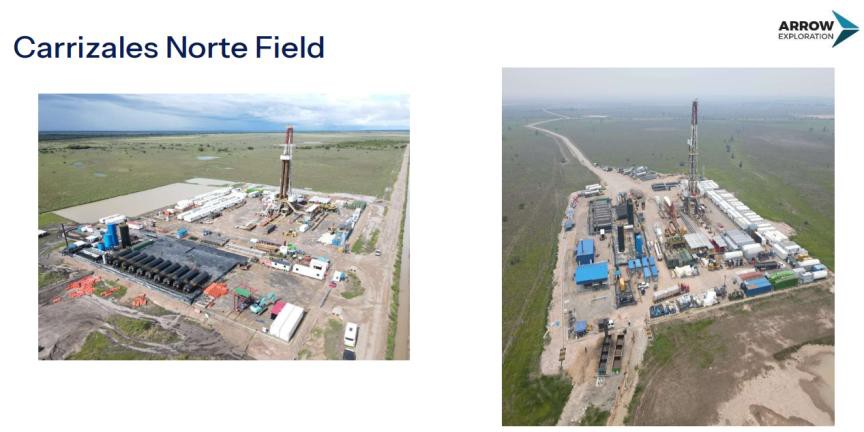
Arrow is an interesting, and attractively valued, oil and gas company. It has $28m of net cash, and it is generating sizeable quantities of free cash flow (FCF). Its main producing asset is a 50% interest in the Tapir block in the Llanos basin of Colombia. This is an onshore block, which extends over 65,000 acres, and an example of one of the producing wells can be seen below.
Chart 1: An example of one of Arrow’s onshore wells in Colombia
Source: Arrow Exploration plc
More than 95% of Arrow’s output is light oil and this is priced relative to the prevailing price of Brent Crude, a well-known reference point in the oil market. The Tapir Block contains the Icaco, Carrizales Norte, RCE, Alberta, and Mateguafa Fields. They are all producing and Arrow believes that they provide a strong foundation for further
exploration. New prospects within the block have been identified as Oxbow, Macoya, and Capullo. At least one has multiple target zones.
In addition to their 50% interest in four oil blocks in Colombia, Arrow also holds oil and natural gas leases in Canada. Natural gas production in Canada is from wells called Fir (32% working interest) and Pepper (100% working interest) in Alberta. In mid-August, Arrow acquired a 100% working interest in an oil producing property in the Thorsby area of Central Alberta with an effective date of 1 June. This is one factor that has helped Arrow to increase production to over 6,500 boe/d. The acquisition price was approximately $8.9m. This was funded from Arrow’s cash reserves (which have subsequently been rebuilt, as cash as of 1 September was $21.8m vs. $28m as of 1 October).
Hybridan Comment: Arrow’s current production is over 6,500 oil equivalent barrels per day (boe/d). This is exceptionally modest compared with an oil major such as Shell (output of over 1.73m boe/d), but it still translates to some impressive free cash flow (FCF). Consensus forecasts on Alpha Terminal suggest $34.6m (£26m) of FCF in the current financial year (12 months to 31 December 2026 (FY ‘26)), relative to the current EV (enterprise value) of £93.2m, that translates to a FY ’26 FCF yield of 27.9%. That’s a very attractive rate of return, and it may seem too good to be true, but it reflects the fact that Arrow is characterised as having a higher-than-average risk. This is partly because most of its assets are in Colombia, but it is also because its licence to operate in the Tapir block is due to expire in February 2028.
In our view, however, there would appear to be an attractive ‘asymmetry’ to the risk profile. The downside for Arrow would appear to be protected by the $85m or so in FCF that it is forecast to generate over FY ’26 and FY ’27, as that FCF total in GBP terms is roughly
£64m and just under 70% of the current EV. The upside could be far better than everyone appears to assume, as Arrow’s Tapir contract does contain two five-year extension provisions that can be granted at the discretion of Ecopetrol, the Colombian State oil company.
The recent August 2026 Presidential election in Colombia was won by the conservative, right-wing candidate, Abelardo de La Espriella, and his new administration is widely accepted to be very “pro-business” (having pledged to simplify taxes, cut red-tape, and encourage more foreign investment). Crucially, he is also “pro-oil” as he has announced plans to revoke his predecessor’s ban on new oil and gas exploration licences.
In deciding whether Arrow’s licence should be extended, we understand that Ecopetrol will be looking at several considerations. These range from harmonious relations with the local community, to compliance with capital commitments made at the time of the lease being granted. Arrow believes that it will pass on all fronts. It has been operating in Columbia since 2018, and it points out that it has actively benefitted the country over the intervening years via: five new oil discoveries; its total investment (which includes 26km of roads); the taxes that it has paid; and the large number of local employment. The Tapir block would appear to be too small for Ecopetrol to grab for themselves (their output is north of 700,000 boe/d), but the decision still needs to go through a number of their committees (technical, social, legal etc.)), and there may not be any clarity on an extension to Arrow’s Tapir licence until the early part of 2027.
Even with a new pro-business President in power, Colombia may still be a ‘rogue’ choice for some, but oil does make up 30% or so of its exports, and the country does have a good fiscal regime. Arrow also has good access to supporting infrastructure (pipelines, ports etc).
Arrow’s current production total of “over 6,500 boe/d” (as noted in a regulatory news release on 22 October) is up from the 3,767 boe/d average output seen in the three months to 30 June 2025, and the 4,902 boe/d average output recorded for the three months to 30 June 2026.
Arrow’s production has been boosted since June by the small, bolt-on acquisition in Canada, but the more important contributor has been two recently drilled wells – Icaco 8 (IC-8) and Icaco 7 (IC-7) on the Tapir block in Colombia. The Icaco field was discovered in the second quarter of 2026 with the drilling of the Icaco-1 well. As of August 15, six wells were drilled, three of them producing from the Carbonera formation, and two from the Ubaque formation. The last was a water disposal well. Arrow stated at the time that it was proposing to develop an additional five wells, and if it was merited, a further five wells thereafter. This would result in a total of fifteen oil wells and one water disposal well on the Icaco ‘pad’. IC-7 and IC-8 have clearly lifted the total closer to the target of fifteen, and a new horizontal well (IC – HZ9) should boost output further. Arrow’s management team believes that production of up to 10,000 boe/d is possible given bolt-on deal potential and the extent of their prospect-rich inventory.
Every extra barrel means extra costs, and additional royalties, but as the following chart illustrates, Arrow still retain a healthy proportion of every Brent crude-linked barrel that it sells. The per barrel gross profit that it makes is called ‘netback’ in oil industry parlance and that is why the term is deployed in the chart. Oil prices above $100 a barrel are not included in the chart, but the lack of any ‘ratchet’ in royalties across the lower price bands is de facto evidence that Arrow should be capturing a healthy proportion of current prices.
Chart 2: Arrow’s gross profit per barrel at varying oil prices
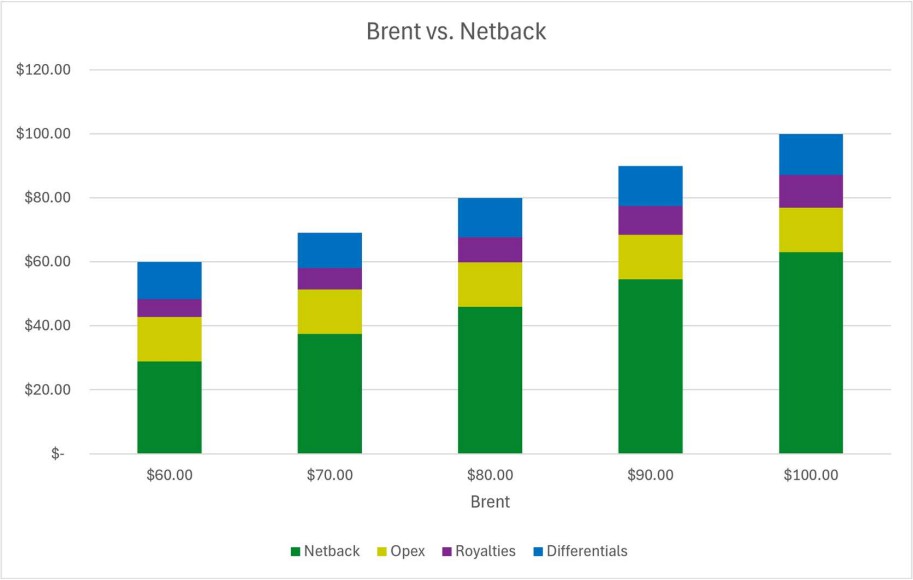
Source: Arrow Exploration plc (with opex meaning operational expenditure, and differentials reflecting the discount that it gets relative to the prevailing price of Brent.)
Arrow is well-managed, and relative to the FCF that it is generating, it appears to be attractively valued. If a Colombian licence extension can be secured, there is good potential for further progression in the share price.
Upland Resources Limited 2.825p £48.80m (UPL.L)
| Price | Results | Top Shareholders | Value Drivers |
|---|---|---|---|
| 2.825p | Year End 31 December | Mr N B Zakaria 8.65% | Interesting US exposure |
| Spread 1.77% | Reported 28 April | Datuk Bolhassan Di (Chairman and CEO) 6.25% | Great SE Asia potential |
| 52-week High/Low 3.9p/2.22p | Interims to 30 June, reported 25 September | Lost Soldier Oil & Gas LLC 5.79% | Connected Chairman |
Source: Alpha Terminal, Company website
Upland Resources is a UK-listed upstream oil and gas Company. It has an in-house drilling unit (Vanguard Drilling Limited, which was acquired in October 2025), and a strategic partnership with a US business called Lost Soldier Oil & Gas. This strategic partnership is underpinned by a cross-shareholding, and a US$100m funding commitment by Lost Soldier for potential upstream projects that Upland has in Southeast Asia between 2026 and 2030.
On 21 September, Upland drew attention to the fact that Lost Soldier had ‘spudded’ a third well (codenamed GMF-5) on a large gas field in the Wild Mustang ‘Federal Unit’ in Wyoming. Drilling and well operations should finish by late November, with results released thereafter.
NB – Wild Mustang is termed a ‘Federal Unit’ as the Bureau of Land Management in the US organises multiple separate federal energy leases into a single ‘unit’, so that they can be managed, drilled, and operated together as a single entity rather than as disparate/fragmented properties.
GMF-5 marks the start of the second phase of development work at Wild Mustang, and following the two holes drilled as part of the phase one programme. Lost Soldier suggested that they were targeting potential resources of up to five to six trillion cubic feet (Tcf) of gas across multiple stacked natural gas formations. The GMF-5 well will be drilled down to approximately 19,000 feet, and it will target a new over-pressured zone beneath formations identified from the first two wells in phase one.
In oil terms, five Tcf of gas would represent 833m barrels – a sizable prize for any small exploration company.
Lost Soldier holds almost 5.8% of Upland. In turn, Upland has invested approximately US$4.3m in Lost Soldier (which is private and not listed). It also holds a further US$9.5m worth of options in Class C units issued by Lost Soldier. These expire on 31st December 2030. The Class C units carry a royalty interest on all production from the Wild Mustang Federal Unit leases, with no exposure to well costs or operating liabilities. Therefore, any additional
volumes discovered through the phase two programme would benefit Upland at no further cost. This is subject to commercial production. The good news therein is that Lost Soldier is currently constructing a 5.3-mile, 8-inch connector pipeline to connect the Wild Mustang wells to a nearby, high-capacity 20-inch transmission line, with initial commercial gas sales targeted by the year-end (subject to completion of the required development activities and approvals).
Developments in the US could have positive ramifications for Upland’s share price, but followers of the business will also be hoping for news that a Production Sharing Contract (PSC) has been awarded to the Company in Southeast Asia.
Upland stated in September that various asset-level developments in the region were “progressing towards key milestones”. We thought at the time that the first deal could be in Aceh, Indonesia, as Upland announced a Memorandum of Understanding (MOU) back in February for participation in Block MY1 and Block MY2 in Aceh. This was in collaboration with PEMA, the local government-owned energy and mineral investment authority, and Upland suggested at the time that the MOU would be followed by a binding ‘Heads of Agreement’ on a direct award PSC.
However, Upland has also partnered with Petroleum Sarawak Berhad, the state-owned petroleum company of Sarawak that is commonly known as PETROS, to undertake a joint technical study on the hydrocarbon potential of an onshore block called ‘SK334’. This covers a large 6,685 square kilometre area in the northernmost part of Sarawak across two districts called Limbang and Lawas. Onshore Sarawak has huge appeal as it is contiguous to discovered oilfields across the land border with Brunei that have analogous geology, and where production was established almost one hundred years ago.
NB – The ten well drilling campaign that PETROS has recently flagged for onshore Sarawak follows on from ‘de-risking’ work undertook late last year via seismic reprocessing and enhanced full tensor gravity gradiometry (FTG) data. FTG is an advanced geophysical surveying technique (conducted using a light aircraft in the case of onshore areas), which measures very small changes in the earth’s gravity field to help map sub-surface structures.
Hybridan Comment: A PSC in Southeast Asia may seem like a pipedream for a small UK-listed business, but it is important to appreciate the credentials of Upland’s Chairman and CEO, Datuk Bolhassan Di.
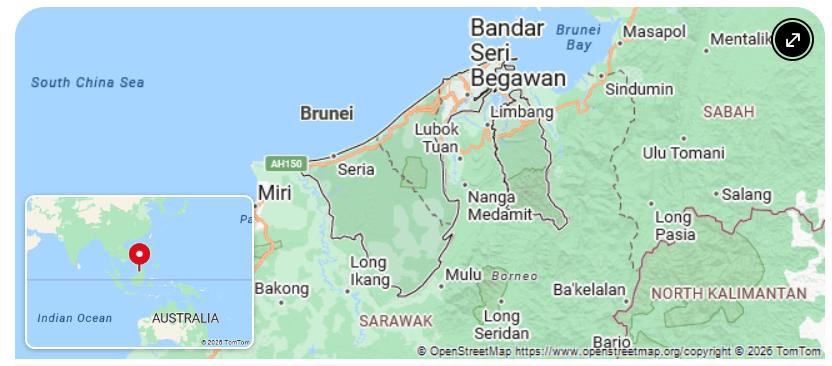
A graduate of the School of Engineering at Sheffield University, he began his career in 1979 at Sarawak Shell Berhad (a subsidiary of Royal Dutch Shell). This gave him experience in project planning, design, construction, and start-up experience in offshore hydrocarbon projects. These included the F6A project in Sarawak waters, the largest offshore gas project in the region). Crucially, Datuk Bolhassan Di was also an elected member of the Sarawak State Legislative Assembly from 1987 to 2011, and Chairman of the Miri Port Authority in Sarawak, from 1987 to 1997. Miri can be seen clearly on the map below, as it is just southwest of the border with Brunei.
Chart 3: Brunei and surrounding aspects of Sarawak
Source: OpenStreetMap
On 21 October, the Borneo Post reported that PETROS plans to invest in ten onshore exploration wells. Sarawak’s Deputy Premier, Datuk Amar Awang Tengah Ali Hasan, was quoted as saying that the planned exploration followed “the revival of Sarawak’s onshore petroleum production after nearly five decades”. Upland highlighted in a news release that the Limbang–Lawas district (which borders the eastern side of Brunei on the map above) is explicitly included in the planned ten well programme.
SK334 is a sizable onshore block on the border with Brunei. We do not have any insight into exactly where any drilling will take place, but logically, one would expect the drill bit will target the most prospective area detailed in the joint technical study. Nothing guarantees exploration success, or subsequent involvement in a discovery, but we note that Upland Big Oil, a subsidiary of Upland Resources, has what the management team refer to as “unique privileges” enshrined in its joint study agreement with PETROS.
With Datuk Bolhassan Di backed by the combination of an experienced team, a sophisticated in-house drilling resource, and imminent cashflows from Lost Soldier’s US gas production, Upland shareholders will now be hoping that assiduous technical preparation in Sarawak is followed by a successful drilling campaign, and the award of a PSC.
Upland’s Chief Operating Officer is Gerry Murray, who has an MSc in Oil and Gas Enterprise Management from Aberdeen University, and major capital project experience with companies such as Chevron, BP and Aker Solutions. The CEO of Upland Big Oil is Thomas Nyanat, a distinguished geologist and oil and gas professional with over four decades of global experience in technical and leadership roles. He graduated with a geology degree from the National University of Malaysia. His key expertise includes exploration and development geology, reservoir management, and unconventional resources for both Onshore and Offshore environments. His career has included Chief Petroleum Engineer with Shell Malaysia, and General Manager for Onshore Assets with PETROS. Sarawak is just one of several other possible SE Asian developments that Upland could profit from, and related news flow is keenly awaited.
Spotlight on a house stock
Orcadian Energy 14.5p £11.64m (ORCA.L)*
Orcadian has an interest in two North Sea gas fields – Earlham and Orwell, and several heavy oil fields, which are also located in the North Sea. To monetise the gas fields, Orcadian is working on an offshore data centre project. This has manifold benefits, take grid connectivity. It is a known problem, with the UK’s energy transition and new sources of demand resulting in a long queue and attendant demands for a large deposit to secure one’s place in the queue. However, by locating a data centre offshore with a dedicated power station, there is no need for the grid link. The fuel for the power station comes from gas fields that Orcadian already has (Earlham and Orwell respectively), and it estimates that the cost of carbon abated power will be roughly £124 per megawatt hour. That is just over half the cost of grid supplied electricity.
Chart 4: Schematic of the proposed offshore data centre complex
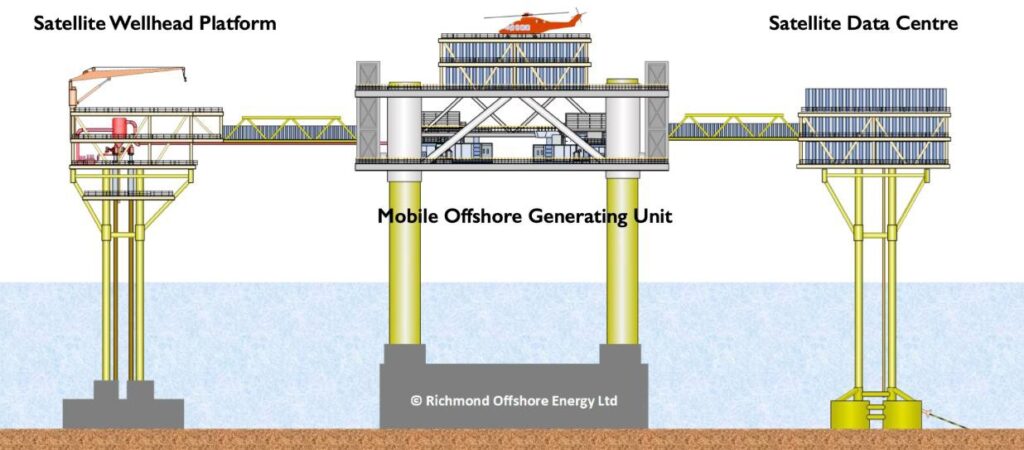
Source: Orcadian Energy PLC and Richmond Offshore Energy Ltd
Orcadian do need a partner for the data centre aspect of the project, and in our view, a neo-scaler such as CoreWeave (NASDAY: CRWV), or the Dutch Company Nebius (NASDAY: NBIS), would be ideal. Via a joint venture agreement, they would develop the offshore compute platform; and then sell the compute capacity to customers. The hardware element could be lease financed or owned. The practicality of an offshore project may be questioned, but those familiar with the under-sea data centre located 10km off the coast of Shanghai at a water depth of over 10 metres (built by HiCloud Technology and China Communications Construction Company), will conclude that the technical aspects of the project are not too demanding.
Based on Space X’s ‘minihard’ data centre design in Memphis, Orcadian believes that a 200MW IT load data centre – with c.1,500 racks; and c. 110,000 Nvidia GB300 chips – would
require roughly 14,500 square metres of space. On land, that is equivalent to the footprint of a large hypermarket, but on a new 50 metre by 50 metre offshore platform, it equates to just six floors of modular structures. Locating the data centre’s power station offshore dispenses with the need for high voltage transformers, AC/DC converters, and an electrical cable to connect to the grid on land. There are also no land acquisition/lease costs, and no business rates to pay. Crucially, there is also limited scope for objectors to bemoan the prospect of a data centre ‘blotting’ the landscape. Orcadian estimates that the whole project could be up and running within two years of any financing decision.
In addition to the Earlham and Orwell gas field, Orcadian also owns various-sized interests in several North Sea oil fields. The most important are Pilot, Elke, Narwhal, and Fynn.
Pilot is a central North Sea oil field in the licence area P2244. Orcadian farmed out an 81.25% interest to a Malaysian-owned business called Ping Petroleum in March 2024. The 18.75% stake retained by Orcadian is a ‘carried interest’. This means that Orcadian does not have to pay any related development costs, but after the first offload of oil produced from the field, Orcadian’s revenue share reduces to 10% until Ping is paid back. The reservoir quality of Pilot has been described as “excellent” by Orcadian, and it contains almost 79m barrels of contingent resource (which would become a ‘2P’ proven and probable resource once a field development plan is approved). The barrels in question are a viscous oil ranging in gravity from 17º API in the South of the reservoir to 12º API in the North. API refers to the American Petroleum Institute’s measures for density. As the oil is viscous, Orcadian believes that Pilot’s development will be optimised by a combination of polymer flooding and wind power from a floating wind turbine or a local wind farm. Polymer significantly reduces fluid handling requirements and hence energy consumption as well as boosting recovery. It is worth noting therein, that Ithaca Energy (ITH.L) has enjoyed consistent success in applying polymer flooding to the highly analogous ‘Captain’ field in the Inner Moray Firth.
The Elke and Narwhal discoveries are about 150km east of Aberdeen. The fields contain an aggregate 54m barrels of contingent resource, with the potential of doubling that resource base through appraisal. The Fynn field (50% owned) adds additional support for the underlying investment case on Orcadian as it contains a very substantial heavy oil discovery. About 88% of the resource (on a best technical case) is estimated to lie within the area of the licence area, which is in the Outer Moray Firth off the coast of Inverness. The licence is operated by Serica Energy Plc (SQZ.L), and they acquired their interest after completing the purchase of Parkmead (E&P) Limited in April 2025. The heavy oil accumulation has been proven by three wells and based on reservoir modelling undertaken for the operator, Orcadian believes that a warm (140ºF) polymer flood would result in a high recovery factor. Parkmead estimated that oil-in-place at Fynn could be between 740m and
1.33bn barrels, but the field is across several blocks, and the recoverable oil net to Orcadian is more like 128.6m barrels. In our view, that still counts as a very respectable number for a company of Orcadian’s size.
Hybridan Comment: We would argue that there is great scope for investors to reappraise Orcadian’s valuation, and its prospects. Their 18.75% interest in Pilot – the first of their oil projects that is likely to be developed – has a Company-assessed net present value (NPV) of $120m (c.£90m). An additional two North Sea discoveries – Elke and
Narwhal – are 100% owned and they contain an aggregate 54m barrels of contingent resource. Orcadian believes that the two fields could be developed in tandem using a pair of wellhead platforms tied back to a FPSO (Floating Production Storage and Offloading) vessel, which is part of the proposed Pilot field development plan. The NPV of this combined development has been put at $458m at a $60 per barrel real price and a conservative 10% discount rate. The recoverable oil net to Orcadian at Fynn represents a further 128.6m barrels Parkmead has previously described the field as “one of the UK’s largest undeveloped discoveries”.
With Orcadian currently valued at just over £11.64m (or just 13% of their stake in the Pilot field), we would argue that any new investor is getting their main hydrocarbon asset on the cheap. In addition, we would also suggest that an investor is getting a free carry on all the substantial value that could accrete to Orcadian from their other potential projects. The most notable of these is the data centre project, but the development of the Elke, Narwhal, and Fynn fields could also create substantial value for shareholders.
The Earlham and Orwell energy-to-compute data centre project is appealing as it is a solution to a whole host of onshore problems. One would like to think that the chances of support from the regulators for Orcadian’s proposed offshore data centre project are quite good given that there is a UK ‘strategic’ dimension to the project; an employment consideration (in Aberdeen and Norwich); an environmental consideration; and a local ‘political’ consideration (contentious onshore development avoided). It is also worth noting that the North Sea Transition Authority (NSTA) has a statutory duty to maximise the “economic recovery of UK petroleum”. In our view, power for a data centre is a very effective way of delivering that economic recovery.
by James Follows
* House client
** Share prices, market capitalisations, and top 3 Shareholders all reported as at the close on 2 November 2026
Status of this Master Investor Purposed Newsletter, Disclaimer and Disclosures
- Disclaimer for companies mentioned with whom Hybridan does not have a corporate advisory relationship
This document has been provided as a general market commentary and is prepared by Hybridan LLP for information purposes only and should not be construed in any circumstances as investment advice; a recommendation; an offer to sell; nor any offer to buy any security or other financial instrument. Nor shall it, or the fact of its distribution, form the basis of, or be relied upon in connection with, any contract relating to such an action. The information has been provided without taking into account the investment objective, financial situation or needs of any particular person. Recipients should make their own investment decisions based upon their own financial objectives and financial resources and, if any doubt, should seek advice from an investment advisor.
As market commentary, this document is not investment research or a research recommendation for regulatory purposes as it does not constitute substantive research or analysis. It is not subject to any prohibition on dealing ahead of the dissemination of investment research although Hybridan LLP maintains related internal systems and controls in connection with such dealing.
This document should not be relied upon as being an independent or impartial view of the subject matter. The individuals who prepared this document may be involved in providing other financial services to the company or companies referenced in this document or to other companies who might be said to be competitors of the company or companies referenced in this document. As a result, both Hybridan LLP and the individual members, officers and/or employees who prepared this document may have responsibilities that conflict with the interests of the persons who receive this document. Hybridan LLP and/or connected persons may, from time to time, have positions in, make a market in and/or effect transactions in any investment or related investment mentioned herein and may provide financial services to the issuers of such investments.
This document is not intended to be an invitation or inducement to engage in investment activity. In the United Kingdom, this document is directed at and is for distribution only to persons who (i) fall within article 19(5) (persons who have professional experience in matters relating to investments) or article 49(2) (a) to (d) (high net worth companies, unincorporated associations, etc.) of the Financial Services and Markets Act 2000 (Financial Promotion) Order 2005 (SI 2005/1529) (as amended) or (ii) persons who are categorised by Hybridan LLP as either a professional client or eligible counterparty (as those terms are defined in the Financial Conduct Authority’s Conduct of Business Sourcebook) (all such persons referred to in (i) and (ii) together being referred to as “relevant persons”). This document must not be acted on or relied up on by persons who are not relevant persons. For the avoidance of doubt, this document is not intended for and should not be relied upon by any person who would be classified as a retail client under the Financial Conduct Authority’s Conduct of Business Sourcebook.
The information contained in this document is based on materials and sources that are believed to be reliable; however, they have not been independently verified and are not guaranteed as being accurate. This document is not intended to be a complete statement or summary of any securities, markets, reports or developments referred to herein. The information may contain projections or other forward-looking statements regarding future events, targets or expectations. There is no assurance that such events or expectations will be achieved, and actual results may be significantly different from that shown here. The information is based on current market conditions, which will fluctuate and may be superseded by subsequent market events or for other reasons. Any and all opinions expressed are current opinions as of the date appearing on this document only. Any and all opinions expressed are subject to change without notice and Hybridan LLP is under no obligation to update the information contained herein.
References to specific securities, asset classes and financial markets are for illustrative purposes only. Past performance is no guarantee of future results. Information and opinions presented have been obtained or derived from sources which Hybridan LLP reasonably believed to be reliable however no representation or warranty, either express or implied, is made or accepted by Hybridan LLP, its members, directors, officers, employees, agents or associated undertakings in relation to the accuracy, completeness or reliability of the information in this document nor should it be relied upon as such.
To the fullest extent permitted by law, none of Hybridan LLP, its members, directors, officers, employees, agents or associated undertakings shall have any liability whatsoever for any losses arising in any way from use of all or any part of the information in this document including, for the avoidance of doubt, direct or indirect or consequential loss or damage (including lost profits).
Neither this document nor any copy of part thereof may be distributed in any other jurisdictions where its distribution may be restricted by law and persons into whose possession this document comes should inform themselves about, and observe, any such restrictions. Distribution of this report in any such other jurisdictions may constitute a violation of territorial and/or extra-territorial securities laws, whether in the United Kingdom or any other jurisdiction in any part of the world.
Hybridan LLP and/or its associated undertakings may from time-to-time provide investment advice or other services to, or solicit such business from, any of the companies referred to in this document. Accordingly, information may be available to Hybridan LLP that is not reflected in this material and Hybridan LLP may have acted upon or used the information prior to or immediately following its publication.
In addition, Hybridan LLP, the members, officers and/or employees thereof and/or any connected persons may have an interest in the securities, warrants, futures, options, derivatives or other financial instrument of any of the companies referred to in this document and may from time-to-time add or dispose of such interests.
- Disclaimer for companies mentioned with whom Hybridan has a corporate advisory relationship
Where Hybridan refers to companies that it is a retained adviser to, Hybridan marks this clearly with an *
This document should not be relied upon as being an impartial or objective assessment of the subject matter and does not constitute independent investment research for the purposes of the Conduct of Business Sourcebook (“COBS”) issued by the Financial Conduct Authority (“FCA”) to reflect the requirements of the UK retained version of Regulation 600/2014/EU (the “MIFID II Regulation”) and the UK retained version of Directive 2014/65/EU (the “MIFID II Directive”) and all rules made in connection therewith (together, known as “MIFID II”). The individuals who prepared this document may be interested in shares in the company concerned and/or other companies within its sector. As a consequence, the research (a) has not been prepared in accordance with legal requirements designed to promote the independence of investment research under MIFID II; and (b) is not subject to any prohibition on dealing ahead of the dissemination of investment research (although Hybridan does impose restrictions on personal account dealing in the run up to publishing research as set out in our Conflicts of Interest Policy).
This document has been issued by Hybridan LLP as a marketing communication for information purposes only and should not be construed in any circumstances as an offer to sell or solicitation of any offer to buy any security or other financial instrument, nor shall it, or the fact of its distribution, form the basis of, or be relied upon in connection with, any contract relating to such action. This document has no regard for the specific investment objectives, financial situation or needs of any specific entity. Hybridan LLP and/or connected persons may, from time to time, effect transactions in any investment or related investment mentioned herein and may provide financial services to the issuers of such investments. The information contained herein is based on materials and sources that we believe to be reliable, however, Hybridan LLP makes no representation or warranty, either express or implied, in relation to the accuracy, completeness or reliability of the information contained herein. Opinions expressed are our current opinions as of the date appearing on this material only. Any opinions expressed are subject to change without notice and Hybridan LLP is under no obligation to update the information contained herein. None of Hybridan LLP, its affiliates or employees shall have any liability whatsoever for any indirect or consequential loss or damage arising from any use of this document.
This document is not intended to be an invitation or inducement to engage in investment activity. In the United Kingdom, this report is directed at and is for distribution only to persons who (i) fall within article 19(1) (persons who have professional experience in matters relating to investments) or article 49(2) (a) to (d) (high net worth companies, unincorporated associations, etc) of the Financial Services and Markets Act 2000 (Financial Promotions) Order 2005 (SI 2005/1529) (as amended) or (ii) persons who are categorised by Hybridan LLP as either a professional client or eligible counterparty (as those terms are defined in COBS (issued by the FCA) (all such persons together being referred to as “relevant persons”). This report must not be acted on or relied upon by persons in the United Kingdom who are not relevant persons.
Neither this report, nor any copy or part thereof may be distributed in any other jurisdictions where its distribution may be restricted by law and persons into whose possession this report comes should inform him or herself about and observe any such restrictions. Distribution of this report in any such other jurisdictions may constitute a violation of securities laws in the United Kingdom, the United States (or any part thereof) or any other jurisdiction in any other part of the world.
The methodology and underlying assumptions used to either evaluate a financial instrument or an issuer shall, where relevant, be included (with information as to where any more detailed information can be found) in the substance of this note.
Investments in general involve some degree of risk, including the risk of capital loss. The services, securities and investments discussed in this document may not be available to or suitable for all investors. Investors should make their own investment decisions based upon their own financial objectives and financial resources and, if in any doubt, should seek advice from an investment advisor. Past performance is not necessarily a guide to future performance and an investor may not get back the amount originally invested. Where investment is made in currencies other than the investor’s base currency, movements in exchange rates will have an effect on the value, either favourable or unfavourable. Levels and bases for taxation may change. When Hybridan LLP comments on AIM or AQSE Exchange shares investors should be aware that because the rules for those markets are less demanding than the Official List of the London Stock Exchange the risks are higher. Furthermore, the marketability of these shares is often restricted.
Hybridan LLP is authorised and regulated by the FCA and is a member of the London Stock Exchange.
Issuers may be permitted to review investment analysts’ investment research prior to publication for review of factual accuracy only – all opinions expressed are our own. Investment research prepared by Hybridan LLP is monitored to ensure that it is only provided to relevant persons. Research prepared by Hybridan LLP is not intended to be received and/or used by any person who is categorised as a retail client under COBS.
Investment analyst certification: All research is issued under the regulatory oversight of Hybridan LLP. Each investment analyst of Hybridan LLP whose name appears as the author of this research hereby certifies that the opinions expressed in such research accurately reflect the investment analyst’s personal and objective views about any and all of the companies or the Company discussed herein that are within such investment analyst’s coverage universe.
The investment analyst who is responsible for the preparation of any commentary on companies that Hybridan advises is Jonathan (Jon) Levinson, who is an employee of Hybridan.
Conflicts of Interest: Hybridan LLP is involved in providing other financial services to companies it includes in this note that it is a retained adviser to and, as a result, Hybridan LLP may have responsibilities to the Company which conflict with the interests of the persons who receive this document.
Hybridan LLP and/or its associated companies may from time-to-time provide investment advice or other services to, or solicit such business from, any of the companies referred to in this document. Accordingly, information may be available to Hybridan LLP that is not reflected in this material and Hybridan LLP may have acted upon or used the information prior to or immediately following its publication.
Hybridan, its partners, officers or employees or any connected persons may at the time of publication have an interest in the equity of the Company through the holding of warrants, securities, futures, options, derivatives, and any other financial instrument of any of the companies referred to in this document. Hybridan at the time of publication currently has no interest of this nature in the Company discussed herein. If exercised such interest would not be required to be notified as it would comprise less than 3% of the Company’s issued share capital. Hybridan reserves the right to increase or dispose of this interest and/or the underlying shares resulting from exercise, without further notice. Any disposal or acquisition of warrants or shares will be undertaken under the FCA Disclosure Guidance and Transparency Rules Sourcebook.
No recommendations: In line with our conflicts of interest policy Hybridan LLP does not produce “buy” or “sell” recommendations or publish target prices on companies who are corporate clients of Hybridan LLP.
MIFID II status of Hybridan LLP research: The cost of production of our corporate research is met by retainers from our corporate broking clients. In addition, from time to time we issue further communications as market commentary (such as our daily newsletter), which we consider to constitute a minor non-monetary benefit which is capable of enhancing the quality of service provided by Hybridan LLP and which is of a scale and nature which could not be judged to impair the duty of Hybridan LLP to act in the best interest of its client falling within article 24(7)(b) of the MIFID II Regulation.
Unless otherwise stated, Hybridan LLP owns the intellectual property rights and any other rights in this document. This document may not be copied, redistributed, resent, forwarded, disclosed or duplicated in any form or by any means, whether in whole or in part other than with the prior written consent of Hybridan LLP.
Hybridan LLP is a limited liability partnership registered in England and Wales, registered number OC325178, and is authorised and regulated by the Financial Conduct Authority and is a member of the London Stock Exchange. Any reference to a partner in relation to Hybridan LLP is to a member of Hybridan LLP or an employee with equivalent standing and qualifications. A list of the members of Hybridan LLP is available for inspection at the registered office, 2 Jardine House, The Harrovian Business Village, Bessborough Road, Harrow, Middlesex HA1 3EX.
This document should be directed at and is for distribution only to persons who (i) fall within article 19(5) (persons who have professional experience in matters relating to investments) or article 49(2) (a) to (d) (high net worth companies, unincorporated associations, etc.) of the Financial Services and Markets Act 2000 (Financial Promotion) Order 2005 (SI 2005/1529) (as amended) or (ii) persons who are categorised as either a professional client or eligible counterparty (as those terms are defined in the Financial Conduct Authority’s Conduct of Business Sourcebook) (all such persons referred to in (i) and (ii) together being referred to as “relevant persons”). This document must not be acted on or relied up on by persons who are not relevant persons. For the avoidance of doubt, this document is not intended for and should not be relied upon by any person who would be classified as a retail client under the Financial Conduct Authority’s Conduct of Business Sourcebook. A full disclaimer and set of disclosures are made at the end of this report.